
Brain Research
“...neuroimaging has shown that bilingualism can enhance attention and sensitivity to sounds, even past infancy, and even if you begin to learn another language later in life. Bilingualism can also make your brain more efficient at managing the immense volume of information that comes streaming in on a second-to-second basis, helping you focus on what matters and ignore distracting inputs.”
“...extensive exposure to multilingual speech can result in more robust encoding of sounds in the evolutionarily ancient brainstem, as well as increased gray and white matter in the primary auditory cortex. As a result, after training, even adults may find it easier to perceive foreign speech sounds, as well as mimic foreign accents, compared to monolinguals.”
“Just as having stronger muscles allows you to lift weights with less effort, increased gray matter in classic executive control regions may make it easier for bilinguals to manage irrelevant information. Bilinguals also have increased white matter in the tracts connecting frontal control areas to posterior and subcortical sensory and motor regions, which may allow them to off-load some of the work to areas that handle more procedural activities. Because the same neural machinery can be used for both linguistic and nonlinguistic tasks, multilingual experience can even affect performance in contexts that involve no language at all.”
“Increased gray and white matter, as well as the ability to flexibly recruit different brain regions, may help explain why bilingualism can delay the onset of dementia symptoms by four to six years. Fortunately, there doesn’t appear to be a deadline for fortifying your brain, as learning a foreign language can still have an impact well into adulthood and after relatively brief amounts of training. Furthermore, changes to one area or function are likely to have cascading effects; better cognitive control can enhance auditory processing, which may facilitate further language learning and continued neural restructuring.”
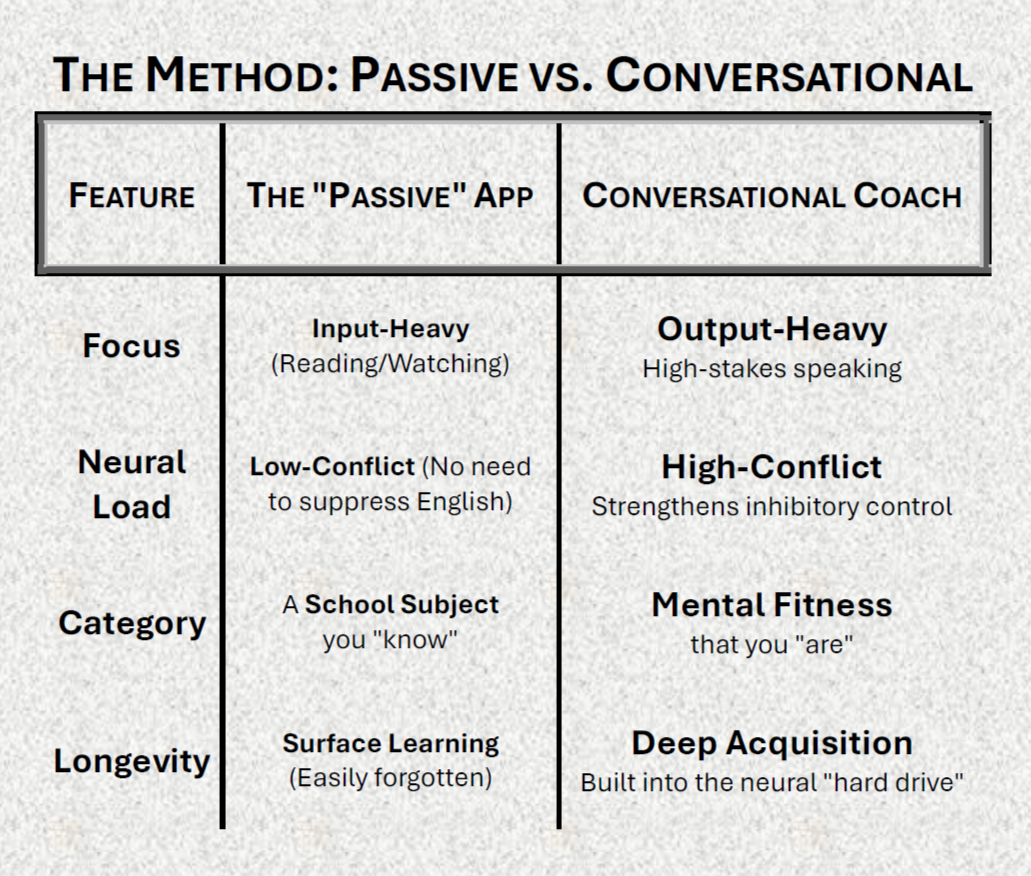
To maintain the relative balance between two languages, the bilingual brain relies on executive functions, a regulatory system of general cognitive abilities that includes processes such as attention and inhibition. Because both of a bilingual person’s language systems are always active and competing, that person uses these control mechanisms every time she or he speaks or listens. This constant practice strengthens the control mechanisms and changes the associated brain regions.
Bottom line: The brain is a “use it or lose it” organ. We don’t just study Spanish; we use Spanish as a tool to build a faster, more flexible, and more resilient mind.
Sources: Sauyri Hayakawa and Viorica Marian, Scientific American
Bialystok E, Craik FI, Luk G. Bilingualism: Consequences for mind and brain. Trends in Cognitive Sciences. 2012;16(4):240–250.
Green DW. Bilingual worlds. In: Cook V, Bassetti B, editors. Language and bilingual cognition. New York: Psychology Press; 2011. pp. 229–240.